

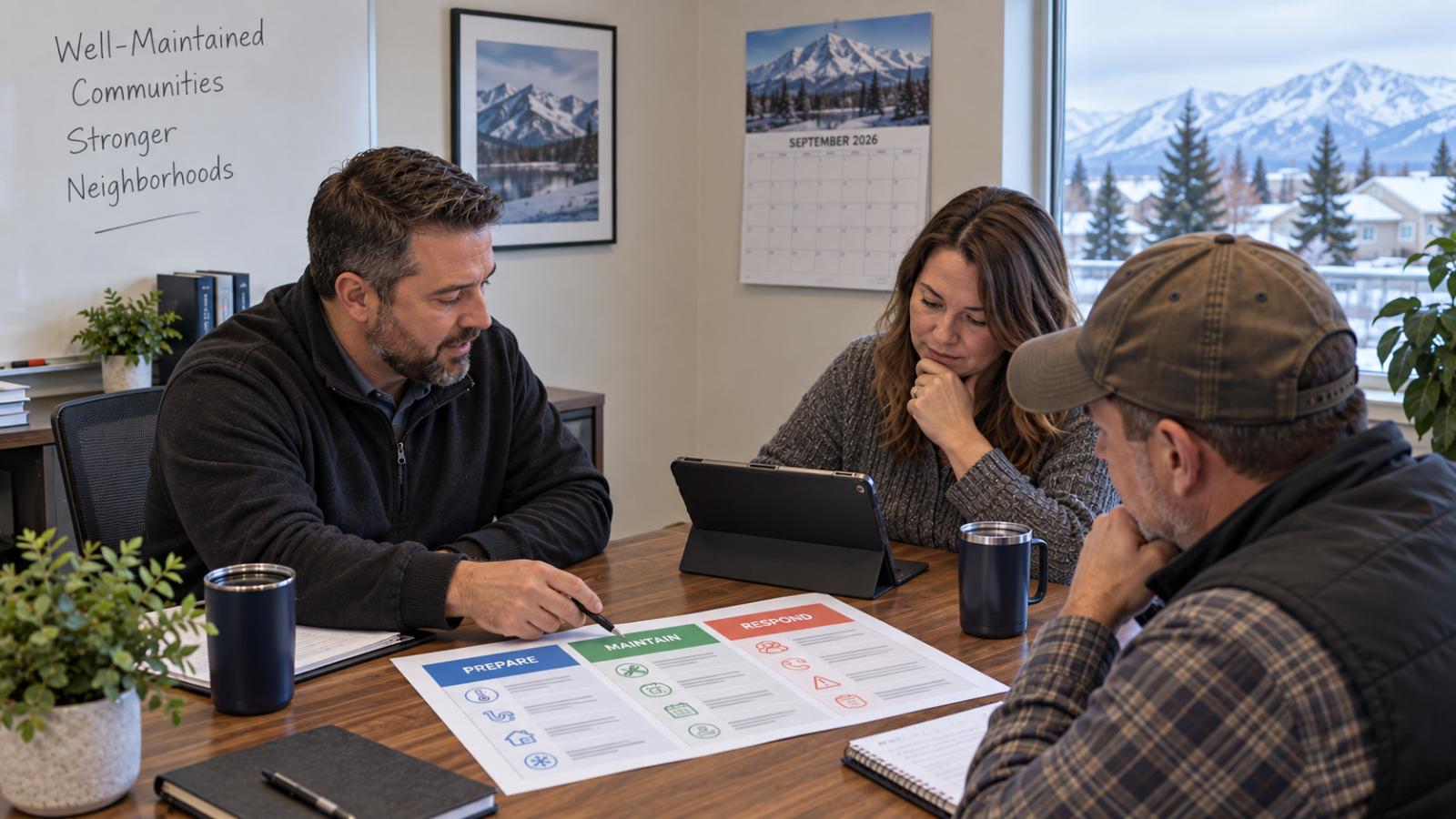
An association budget can balance on paper and still leave a board uncertain about what the numbers mean. Routine expenses may be mixed with future replacement costs. Snow spending may appear as one annual guess. Reserve contributions may be treated as whatever remains after other bills are paid.
For an Alaska HOA or condominium association, that lack of separation makes winter decisions harder. Early October is a useful point to connect current-year actuals, signed vendor terms, reserve information, and the coming year’s operating plan while the board still has time to explain its assumptions.
One practical approach is to organize the budget discussion into three buckets: operations, reserves, and winter contingency. These are planning categories, not a substitute for the association’s accounting method, governing documents, reserve study, or professional advice.
Start With the Current-Year Baseline
Before discussing next year’s assessment level, assemble the best available picture of the current year.
Review:
- Year-to-date income and expenses against budget
- Open invoices and work orders
- Contract commitments and renewal dates
- Assessment collections and delinquency trends
- Insurance, utility, and professional-service costs
- Reserve contributions made and planned
- Approved projects not yet completed
- Winter costs from at least the recent seasons available
Separate timing differences from true variances. An annual premium paid early may make one month look unfavorable even when the annual line is on track. An unpaid invoice can make current spending look artificially low. Add a short explanation beside each material variance so the next board does not have to reconstruct the reason.
Bucket One: Operating Costs
The operating budget covers the recurring work needed to run the community during the budget year. Depending on the property and governing documents, examples may include:
- Management and administrative services
- Routine grounds and common-area maintenance
- Utilities
- Insurance
- Accounting and legal support
- Regular inspections
- Cleaning and waste services
- Routine snow and ice service
- Minor repairs and supplies
- Communications, meetings, and required filings
Build each line from a source. Use a current contract, renewal quote, rate notice, recent actuals, or documented estimate. Avoid carrying the prior year’s number forward without checking what changed.
For variable lines, show both the expected amount and the assumption behind it. A board packet is easier to review when “snow removal” is supported by contract terms and recent usage instead of a round number with no explanation.
Bucket Two: Reserve Contributions and Planned Replacements
Reserves support major repair and replacement of common components over time. The exact components and funding approach depend on the community, its documents, professional studies, and financial policy.
Begin with a component list. It may include private roads, roofs, siding, exterior painting, paving, drainage infrastructure, fences, entry features, shared mechanical systems, lighting, or other common property.
For each component, record:
- Current condition
- Estimated remaining useful life
- Estimated future cost and the date of the estimate
- Existing reserve allocation
- Planned annual contribution
- Inspection or professional update needed
- Board decision or project dependency
A reserve contribution is not simply “extra money.” It connects today’s assessments with future work. If the association lacks a current reserve study or component inventory, the board can still begin by organizing known assets and identifying where professional analysis is needed.
Keep major replacement planning distinct from ordinary repairs. Painting one damaged wall may be an operating repair. A scheduled community-wide exterior program may belong in reserve planning. The association’s documents, accounting policy, and professional guidance should control the final classification.
Bucket Three: Winter Contingency
Winter spending is partly predictable and partly variable. A contract may include a base charge, while additional plowing, hauling, sanding, deicing, roof work, or callouts depend on actual conditions and the contract.
A winter contingency is a transparent allowance for that variability. It should not become a vague miscellaneous line or a substitute for adequate reserves.
Build it from defined scenarios:
- Expected season: Use current contract terms and a reasonable activity assumption.
- Higher-use season: Estimate how added events, hauling, materials, or callouts could affect cost.
- Response threshold: Decide when management or the treasurer must notify the board that spending is approaching the approved allowance.
- Authority path: Confirm who may authorize work within the contract and who approves work outside it.
Whether the allowance appears as part of operating expenses, a separate contingency, or another approved category should be decided with the association’s accountant and governing documents.
Translate the Snow Contract Into Budget Lines
Do not budget from the contract title alone. Extract the cost drivers.
Depending on the agreement, the board may need to identify:
- Seasonal base fee or retainer
- Per-event or per-visit charges
- Trigger depth or service standard
- Sanding and deicing terms
- Snow hauling or relocation
- Loader, equipment, and labor rates
- Sidewalk, stair, and entry service
- Roof or drainage-related winter work
- After-hours or special callouts
- Fuel, material, or disposal adjustments
- Documentation and approval requirements
This review also reveals operational questions. A low snow line may reflect a mild year, delayed invoices, or work billed somewhere else. A high line may reflect contract changes, access problems, added scope, or unusual conditions. Ask for the explanation before setting the next budget.
Add Cash Flow to the Annual View
An annual budget can hide when cash is actually needed. Map major receipts and payments by month.
Consider:
- Assessment due dates
- Insurance premiums
- Contract deposits and renewals
- Seasonal utility peaks
- Reserve transfers
- Annual professional services
- Planned projects
- Snow invoices and material purchases
The goal is not to predict every transaction. It is to identify months when the association may be financially tight even if the annual budget is balanced.
Also separate expected assessment revenue from cash actually collected. Use a documented collection assumption and follow the association’s collection policy. Do not quietly use reserves to cover recurring operating shortfalls without confirming authority and recording the decision.
Document the Board’s Assumptions
The budget package should let another owner or future director understand how the board reached the numbers.
For each significant line, record:
- Source document or estimate
- Date of the information
- Assumption used
- Responsible reviewer
- Known uncertainty
- Follow-up date
Then create a one-page owner summary. Explain the major cost drivers, reserve contribution, winter assumptions, and material changes from the current year in plain language. Avoid promising that assessments will never change or that the contingency will cover every event.
Check Authority, Documents, and Professional Advice
Alaska Statute 34.08.320(a)(2) states that, subject to the declaration and other statutory provisions, a unit owners’ association may adopt and amend budgets for revenues, expenditures, and reserves and collect assessments for common expenses.
That general authority does not answer every community-specific question. Applicability can depend on when and how the community was created, its declaration and bylaws, later amendments, accounting practices, and the decision being considered.
Before adoption, confirm:
- Who prepares, approves, ratifies, or receives the budget under the governing documents
- Required notice and meeting procedures
- Assessment-allocation method
- Reserve restrictions
- Spending and contract authority
- Required disclosures or records
Use Alaska counsel and the association’s accountant for legal and financial questions. A blog checklist should support preparation, not replace advice.
A 60-Minute Board Budget Workshop
Boards can use one focused session to organize the next steps:
First 15 minutes: Review current-year variances and open commitments.
Next 15 minutes: Confirm operating contracts, renewals, and cost assumptions.
Next 15 minutes: Review reserve components, planned contributions, and professional updates.
Final 15 minutes: Test the winter contingency, cash-flow calendar, communication plan, and unresolved decisions.
End with an action list. Assign each missing quote, legal question, reserve update, and owner-communication item to a person and a date.
Clarity Matters More Than One Perfect Number
A useful association budget does more than total the columns. It separates recurring operations from long-term replacements and variable winter exposure. It identifies assumptions, tracks cash timing, and shows owners how today’s decisions connect with future responsibilities.
Real Property Management Last Frontier supports association boards with budgeting, financial reporting, maintenance and vendor coordination, board support, and community communication. A board considering a more organized management process can request information through the verified RPMLF contact page.
This content is provided for general informational and educational purposes only and does not constitute financial, legal, tax, or investment advice. Readers should consult with licensed professionals regarding their specific circumstances.
We are pledged to the letter and spirit of U.S. policy for the achievement of equal housing opportunity throughout the Nation. See Equal Housing Opportunity Statement for more information.
